Pass the First Time For The Python Institute PCEP-30-02 Exam
Wiki Article
BONUS!!! Download part of TestSimulate PCEP-30-02 dumps for free: https://drive.google.com/open?id=1if1kZ5vq7IYGpPilQ7xj50zEjyaDy_sd
Even you have no basic knowledge about the PCEP-30-02 study materials. You still can copyright with our help. The key point is that you are serious on our PCEP-30-02 exam questions and not just kidding. Our PCEP-30-02 practice engine can offer you the most professional guidance, which is helpful for your gaining the certificate. And our PCEP-30-02 learning guide contains the most useful content and keypoints which will come up in the real exam.
Python Institute PCEP-30-02 Exam Syllabus Topics:
| Topic | Details |
|---|---|
| Topic 1 |
|
| Topic 2 |
|
| Topic 3 |
|
>> PCEP-30-02 Exam Tutorials <<
PCEP-30-02 Exams Collection & Reliable PCEP-30-02 Test Duration
We offer you free demo to you to have a try before buying PCEP-30-02 study guide, therefore you can have a better understanding of what you are going to buy. Free demo can be find in our website, if you are quite satisfied with the free demo, just add the PCEP-30-02 study guide to shopping cart, after you buy it, our system will send the downloading link and password to you within ten minutes, and you can start your learning right now. Moreover, we offer you free update for one year after you buy the PCEP-30-02 Exam Dumps, therefore you can get the latest version timely.
Python Institute PCEP - Certified Entry-Level Python Programmer Sample Questions (Q15-Q20):
NEW QUESTION # 15
Drag and drop the conditional expressions to obtain a code which outputs * to the screen.
(Note: some code boxes will not be used.)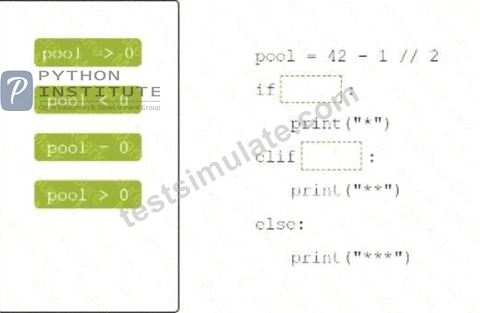
Answer:
Explanation: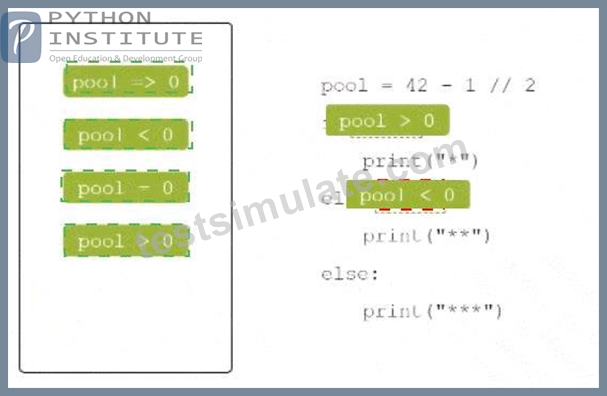
Explanation: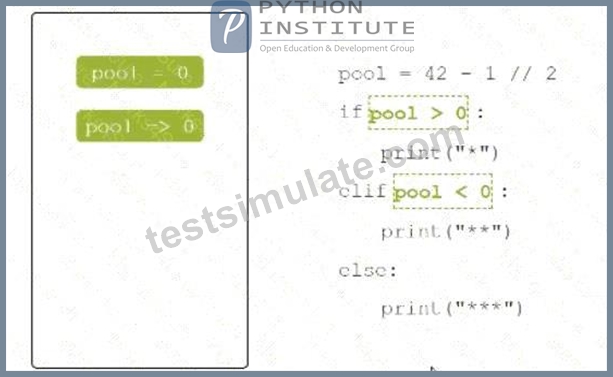
One possible way to drag and drop the conditional expressions to obtain a code which outputs * to the screen is:
if pool > 0:
print("*")
elif pool < 0:
print("**")
else:
print("***")
This code uses the if, elif, and else keywords to create a conditional statement that checks the value of the variable pool. Depending on whether the value is greater than, less than, or equal to zero, the code will print a different pattern of asterisks to the screen. The print function is used to display the output. The code is indented to show the blocks of code that belong to each condition. The code will output * if the value of pool is positive, ** if the value of pool is negative, and *** if the value of pool is zero.
You can find more information about the conditional statements and the print function in Python in the following references:
* [Python If ... Else]
* [Python Print Function]
* [Python Basic Syntax]
NEW QUESTION # 16
What is true about tuples? (Select two answers.)
- A. An empty tuple is written as { } .
- B. The len { } function cannot be applied to tuples.
- C. Tuples can be indexed and sliced like lists.
- D. Tuples are immutable, which means that their contents cannot be changed during their lifetime.
Answer: C,D
Explanation:
Tuples are one of the built-in data types in Python that are used to store collections of data. Tuples have some characteristics that distinguish them from other data types, such as lists, sets, and dictionaries. Some of these characteristics are:
* Tuples are immutable, which means that their contents cannot be changed during their lifetime. Once a tuple is created, it cannot be modified, added, or removed. This makes tuples more stable and reliable than mutable data types. However, this also means that tuples are less flexible and dynamic than mutable data types. For example, if you want to change an element in a tuple, you have to create a new tuple with the modified element and assign it to the same variable12
* Tuples are ordered, which means that the items in a tuple have a defined order and can be accessed by using their index. The index of a tuple starts from 0 for the first item and goes up to the length of the tuple minus one for the last item. The index can also be negative, in which case it counts from the end of the tuple. For example, if you have a tuple t = ("a", "b", "c"), then t[0] returns "a", and t
[-1] returns "c"12
* Tuples can be indexed and sliced like lists, which means that you can get a single item or a sublist of a tuple by using square brackets and specifying the start and end index. For example, if you have a tuple t
= ("a", "b", "c", "d", "e"), then t[2] returns "c", and t[1:4] returns ("b", "c", "d"). Slicing does not raise any exception, even if the start or end index is out of range. It will just return an empty tuple or the closest possible sublist12
* Tuples can contain any data type, such as strings, numbers, booleans, lists, sets, dictionaries, or even other tuples. Tuples can also have duplicate values, which means that the same item can appear more than once in a tuple. For example, you can have a tuple t = (1, 2, 3, 1, 2), which contains two 1s and two
2s12
* Tuples are written with round brackets, which means that you have to enclose the items in a tuple with parentheses. For example, you can create a tuple t = ("a", "b", "c") by using round brackets. However, you can also create a tuple without using round brackets, by just separating the items with commas. For example, you can create the same tuple t = "a", "b", "c" by using commas. This is called tuple packing, and it allows you to assign multiple values to a single variable12
* The len() function can be applied to tuples, which means that you can get the number of items in a tuple by using the len() function. For example, if you have a tuple t = ("a", "b", "c"), then len(t) returns 312
* An empty tuple is written as (), which means that you have to use an empty pair of parentheses to create a tuple with no items. For example, you can create an empty tuple t = () by using empty parentheses.
However, if you want to create a tuple with only one item, you have to add a comma after the item, otherwise Python will not recognize it as a tuple. For example, you can create a tuple with one item t = ("a",) by using a comma12 Therefore, the correct answers are A. Tuples are immutable, which means that their contents cannot be changed during their lifetime. and D. Tuples can be indexed and sliced like lists.
Reference: Python Tuples - W3SchoolsTuples in Python - GeeksforGeeks
NEW QUESTION # 17
A set of rules which defines the ways in which words can be coupled in sentences is called:
- A. syntax
- B. semantics
- C. lexis
- D. dictionary
Answer: A
Explanation:
Syntax is the branch of linguistics that studies the structure and rules of sentences in natural languages. Lexis is the vocabulary of a language. Semantics is the study of meaning in language. A dictionary is a collection of words and their definitions, synonyms, pronunciations, etc.
Reference: [Python Institute - Entry-Level Python Programmer Certification]
NEW QUESTION # 18
Arrange the binary numeric operators in the order which reflects their priorities, where the top-most position has the highest priority and the bottom-most position has the lowest priority.
Answer:
Explanation:
Explanation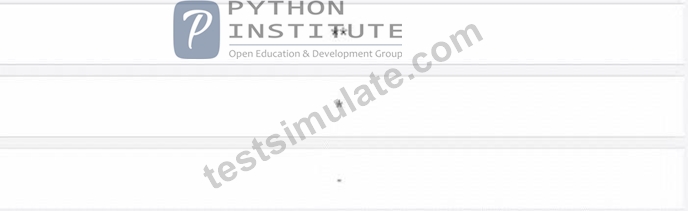
The correct order of the binary numeric operators in Python according to their priorities is:
Exponentiation (**)
Multiplication (*) and Division (
Addition (+) and Subtraction (
This order follows the standard mathematical convention of operator precedence, which can be remembered by the acronym PEMDAS (Parentheses, Exponents, Multiplication/Division, Addition/Subtraction). Operators with higher precedence are evaluated before those with lower precedence, but operators with the same precedence are evaluated from left to right. Parentheses can be used to change the order of evaluation by grouping expressions.
For example, in the expression 2 + 3 * 4 ** 2, the exponentiation operator (**) has the highest priority, so it is evaluated first, resulting in 2 + 3 * 16. Then, the multiplication operator (*) has the next highest priority, so it is evaluated next, resulting in 2 + 48. Finally, the addition operator (+) has the lowest priority, so it is evaluated last, resulting in 50.
You can find more information about the operator precedence in Python in the following references:
6. Expressions - Python 3.11.5 documentation
Precedence and Associativity of Operators in Python - Programiz
Python Operator Priority or Precedence Examples Tutorial
NEW QUESTION # 19
What is true about tuples? (Select two answers.)
- A. An empty tuple is written as { } .
- B. The len { } function cannot be applied to tuples.
- C. Tuples can be indexed and sliced like lists.
- D. Tuples are immutable, which means that their contents cannot be changed during their lifetime.
Answer: C,D
Explanation:
Explanation
Tuples are one of the built-in data types in Python that are used to store collections of data. Tuples have some characteristics that distinguish them from other data types, such as lists, sets, and dictionaries. Some of these characteristics are:
Tuples are immutable, which means that their contents cannot be changed during their lifetime. Once a tuple is created, it cannot be modified, added, or removed. This makes tuples more stable and reliable than mutable data types. However, this also means that tuples are less flexible and dynamic than mutable data types. For example, if you want to change an element in a tuple, you have to create a new tuple with the modified element and assign it to the same variable12 Tuples are ordered, which means that the items in a tuple have a defined order and can be accessed by using their index. The index of a tuple starts from 0 for the first item and goes up to the length of the tuple minus one for the last item. The index can also be negative, in which case it counts from the end of the tuple. For example, if you have a tuple t = ("a", "b", "c"), then t[0] returns "a", and t[-1] returns "c"12 Tuples can be indexed and sliced like lists, which means that you can get a single item or a sublist of a tuple by using square brackets and specifying the start and end index. For example, if you have a tuple t
= ("a", "b", "c", "d", "e"), then t[2] returns "c", and t[1:4] returns ("b", "c", "d"). Slicing does not raise any exception, even if the start or end index is out of range. It will just return an empty tuple or the closest possible sublist12 Tuples can contain any data type, such as strings, numbers, booleans, lists, sets, dictionaries, or even other tuples. Tuples can also have duplicate values, which means that the same item can appear more than once in a tuple. For example, you can have a tuple t = (1, 2, 3, 1, 2), which contains two 1s and two
2s12
Tuples are written with round brackets, which means that you have to enclose the items in a tuple with parentheses. For example, you can create a tuple t = ("a", "b", "c") by using round brackets. However, you can also create a tuple without using round brackets, by just separating the items with commas. For example, you can create the same tuple t = "a", "b", "c" by using commas. This is called tuple packing, and it allows you to assign multiple values to a single variable12 The len() function can be applied to tuples, which means that you can get the number of items in a tuple by using the len() function. For example, if you have a tuple t = ("a", "b", "c"), then len(t) returns 312 An empty tuple is written as (), which means that you have to use an empty pair of parentheses to create a tuple with no items. For example, you can create an empty tuple t = () by using empty parentheses.
However, if you want to create a tuple with only one item, you have to add a comma after the item, otherwise Python will not recognize it as a tuple. For example, you can create a tuple with one item t = ("a",) by using a comma12 Therefore, the correct answers are A.
Tuples are immutable, which means that their contents cannot be changed during their lifetime. and D. Tuples can be indexed and sliced like lists.
NEW QUESTION # 20
......
All the TestSimulate Python Institute PCEP-30-02 practice questions are real and based on actual PCEP - Certified Entry-Level Python Programmer (PCEP-30-02) exam topics. The web-based PCEP - Certified Entry-Level Python Programmer (PCEP-30-02) practice test is compatible with all operating systems like Mac, IOS, Android, and Windows. Because of its browser-based Python Institute PCEP-30-02 Practice Exam, it requires no installation to proceed further. Similarly, Chrome, IE, Firefox, Opera, Safari, and all the major browsers support the PCEP - Certified Entry-Level Python Programmer (PCEP-30-02) practice test.
PCEP-30-02 Exams Collection: https://www.testsimulate.com/PCEP-30-02-study-materials.html
- New PCEP-30-02 Test Registration ???? Latest PCEP-30-02 Dumps Pdf ???? Latest PCEP-30-02 Dumps Pdf ???? Search for ▛ PCEP-30-02 ▟ and easily obtain a free download on ➤ www.practicevce.com ⮘ ⏺PCEP-30-02 Latest Exam Notes
- PCEP-30-02 Popular Exams ???? VCE PCEP-30-02 Dumps ???? PCEP-30-02 Practice Exam Fee ???? ( www.pdfvce.com ) is best website to obtain ▛ PCEP-30-02 ▟ for free download ????Dump PCEP-30-02 Collection
- PCEP-30-02 Reliable Exam Tutorial ???? Latest PCEP-30-02 Learning Materials ???? Latest PCEP-30-02 Learning Materials ???? Search for 「 PCEP-30-02 」 and obtain a free download on ➤ www.pdfdumps.com ⮘ ????PCEP-30-02 Lead2pass Review
- Valid PCEP-30-02 Test Sample ???? Latest PCEP-30-02 Learning Materials ???? VCE PCEP-30-02 Dumps ???? Search for ➽ PCEP-30-02 ???? and download it for free on ⮆ www.pdfvce.com ⮄ website ????Dump PCEP-30-02 Collection
- PCEP-30-02 Exam Vce Free ???? PCEP-30-02 Lead2pass Review ???? Exam PCEP-30-02 Study Guide ???? Copy URL ⮆ www.examcollectionpass.com ⮄ open and search for ➽ PCEP-30-02 ???? to download for free ????PCEP-30-02 Practice Exam Fee
- Quiz 2026 Python Institute PCEP-30-02 – Reliable Exam Tutorials ???? Download ➥ PCEP-30-02 ???? for free by simply searching on { www.pdfvce.com } ????PCEP-30-02 Exam Vce Free
- Pass Guaranteed Quiz PCEP-30-02 - Valid PCEP - Certified Entry-Level Python Programmer Exam Tutorials ???? ⇛ www.examcollectionpass.com ⇚ is best website to obtain “ PCEP-30-02 ” for free download ⏮PCEP-30-02 Latest Exam Notes
- PCEP - Certified Entry-Level Python Programmer pdf test - PCEP-30-02 test dumps ???? ▛ www.pdfvce.com ▟ is best website to obtain ☀ PCEP-30-02 ️☀️ for free download ????Interactive PCEP-30-02 EBook
- PCEP-30-02 Practice Exam Fee ???? New PCEP-30-02 Test Registration ???? VCE PCEP-30-02 Dumps ???? Easily obtain free download of 【 PCEP-30-02 】 by searching on 「 www.pass4test.com 」 ✉PCEP-30-02 Exam Vce Free
- Make Exam Preparation Simple Pdfvce Real Python Institute PCEP-30-02 Exam Questions ???? Enter 《 www.pdfvce.com 》 and search for ☀ PCEP-30-02 ️☀️ to download for free ????VCE PCEP-30-02 Dumps
- Latest PCEP-30-02 Dumps Pdf ???? Interactive PCEP-30-02 EBook ???? Reliable PCEP-30-02 Exam Registration ???? Open ➽ www.examdiscuss.com ???? and search for { PCEP-30-02 } to download exam materials for free ????Latest PCEP-30-02 Dumps Pdf
- www.stes.tyc.edu.tw, thesocialcircles.com, fatallisto.com, caoimhepozc461427.thenerdsblog.com, www.stes.tyc.edu.tw, tessebar895177.blog5star.com, bookmarkingfeed.com, bookmarkingalpha.com, bookmarkleader.com, socialinplace.com, Disposable vapes
2026 Latest TestSimulate PCEP-30-02 copyright and PCEP-30-02 copyright Free Share: https://drive.google.com/open?id=1if1kZ5vq7IYGpPilQ7xj50zEjyaDy_sd
Report this wiki page